26/01/ · “All history is the biography of great men.” History is replete with great heroes but my own hero in history is the Quaid e Azam, Muhammad Ali Jinnah. I like him because of his 24/12/ · Muhammad Ali Jinnah (born Mahomedali Jinnahbhai; 25 December – 11 September ) was a barrister, politician and the founder of Pakistan. [2] Jinnah served as 19/11/ · Muhammad Ali Jinnah quotes "The change in the world is always brought by one man, whom we call "the leader". Who has the vision and the force not only to make people
Quaid-E-Azam Muhammad Ali Jinnah Descriptive Essay Example - blogger.com
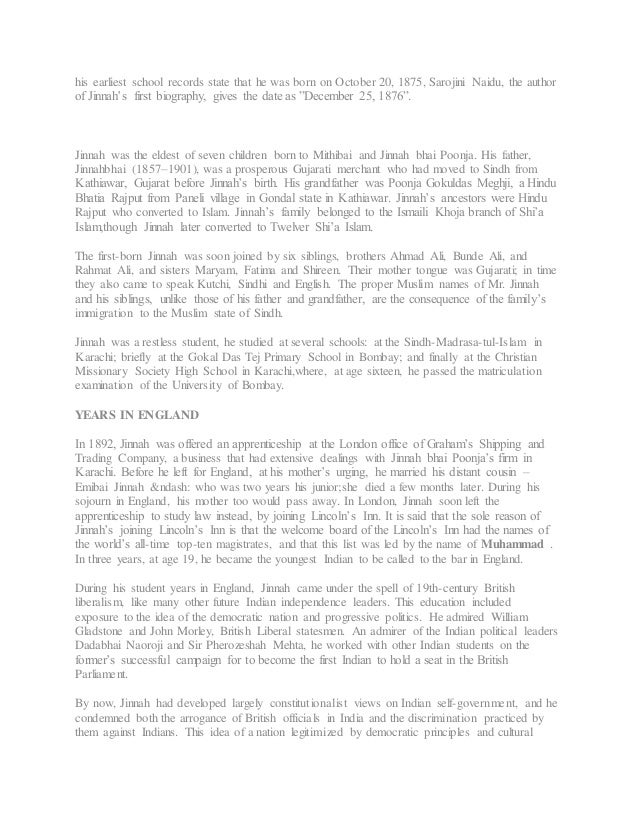
Quaid-e-Azam Muhammad Ali Jinnah My Topic is about any Leader, so In this world there are many leaders. He was a Great politician and statesman of 20th century. He was generally known as the father of state of Pakistan. He was the leader of The Muslim League and served as the first Governor General of Pakistan. Quaid-e-Azam was his official names. His real name is Mohammad Ali Jinnah. Quaid-e-Azam, Muhammad Ali Jinnah was born on 25th December at Wazir Mansion, Karachi of lower Sindh. He was the first of seven children of Jinnah bhai, who was a rich and successful Gujrati merchant. His cast was Rajput, which is an indian cast but these Rajputs were essay on muhammad ali jinnah to Islam.
At first Jinnah was being taught at home then he was sent to the Sindh Madrasah tul Islam in and thn changed his school to Gokal Das Taj Primary School in Essay on muhammad ali jinnah and then finally he joined the Christian Missionary Society High School in Karachi, where at 16 he passed the matric examination of the University of Bombay. On the advice of an English friend, his father decided to send him to England to acquire business experience. Order custom essay Quaid-e-Azam Muhammad Ali Essay on muhammad ali jinnah with free plagiarism report. Jinnah, however, had made up his mind to become a barrister, then in the same yearJinnah joined the office of Graham's Shipping and Trading Company at London, this company had extensive dealings with Jinnahbhai Poonja's firm in Karachi.
In keeping the custom of time, his parents urge him for marrige with his distant cousin Emibai Essay on muhammad ali jinnah, who was two years junior of him. His marriage was not to long last, his wife was died when he was on a temporary stay at England then his mother was also passed away. In London, Jinnah left the Trading Company and joined Lincoln's Inn to study Law. After 3 years at the age of 19 he became the youngest indian to be called to the bar in England essay on muhammad ali jinnah He completed his formal studies and also made a study of the British political system. He was greatly influenced by the liberalism of William E. Gladstone, who had become prime minister for the fourth time in ; that was the year of Jinnah's arrival at London.
Jinnah also took a keen interest in the affairs of India and in Indian students. Their efforts were crowned with success, and Naoroji became the first Indian to sit in the House of Commons. When Jinnah returned to Karachi inhe found that his father's business had suffered losses and that he now had to depend on himself. He decided to start his legal practice in Bombay, but it took him years of work to establish himself as a lawyer. It was nearly 10 years later that he turned toward active politics. A man without hobbies, his interest became divided between law and politics. Nor was he a religious zealot: he was a Muslim in a broad sense and had little to do with group discussion about Islam.
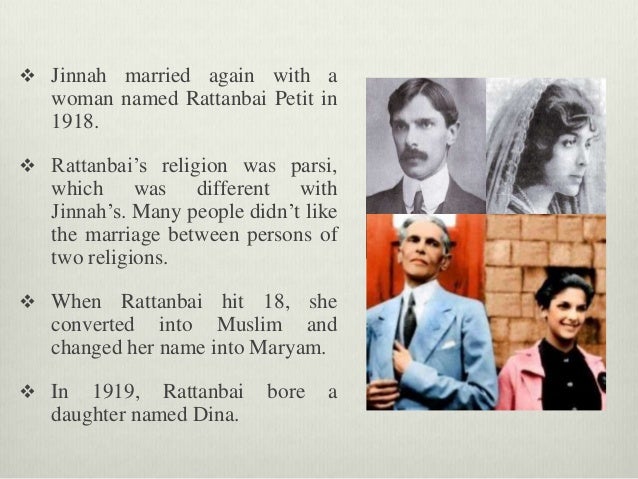
His interest in women was also limited to Ruttenbai, the daughter of Sir Dinshaw Petit, a Bombay Parsi millionaire--whom he married over tremendous opposition from her parents and others. The marriage proved an unhappy one. It was his sister Fatima who gave him solace and company. Jinnah first entered politics by participating in the Calcutta session of the Indian National Congress, Jinnah did not favour totally in Independence, essay on muhammad ali jinnah, he considered British influences on education, law, culture and industry as beneficial to India.
Jinnah became a member on the sixty-member Imperial Legislative Council. Four years later he was elected one of the sixty-member Imperial Legislative Council, then he was appointed to the Sandhurst committee, essay on muhammad ali jinnah, which helped to establish the Indian Military Academy at Dehra Dun. During World War I, Jinnah essay on muhammad ali jinnah other Indian moderates in supporting the British war essay on muhammad ali jinnah, hoping that Indians would be rewarded with political freedoms. He admired the British political system to raise the status essay on muhammad ali jinnah India in the international community and to develop a sense of Indian nationhood among the peoples of India.
At that time, he still looked upon Muslim interests in the context of Indian nationalism. But, by the beginning of the 20th century, the belief had been growing among the Muslims that their interests demanded the preservation of their separate identity rather than live mixed with in the Indian nation, it is impossible for Muslims to be with Hindus. All-India Muslim League was founded in But Jinnah was initially avoiding to join it because it was too Muslim oriented. Eventually, he joined the league in and he became its chief organizer in at Bombay and was elected president of the Bombay branch.
Ambassador of Hindu-Muslim unity," Jinnah, essay on muhammad ali jinnah, tried seriously to bring about the political union of Hindus and Muslims. It gave him the title of "the best ambassador of Hindu-Muslim unity". It was largely through his efforts that the Congress and essay on muhammad ali jinnah Muslim League began to hold their annual sessions jointly, to facilitate mutual consultation and participation. In the two organizations held their meetings in Bombay and in Lucknow inwhere the Lucknow Pact was concluded. Under the terms of the pact, the two organizations put their seal to a scheme of constitutional reform that became their joint demand to the British Government.
There was a good deal of give and take, but the Muslims obtained one important right to use the land in the shape of separate electorates, but they have already admit to be true to them by the government in but upto this time they resisted by the Congress Meanwhile, a new force in Indian politics had appeared in the person of Mohan Das K. Both the Home Rule League and the Indian National Congress had come under his sway. Opposed to Gandhi's Non-co-operation Movement and his necessary Hindu approach to politics, essay on muhammad ali jinnah, Jinnah left both the League and the Congress in For a few years he kept himself away from the main political movements.
He continued to be a firm believer in Hindu-Muslim unity and constitutional methods for the achievement of political ends. After his withdrawal from the Congress, he used the Muslim League platform for the theory of his views. But during the s the Muslim League, and with it Jinnah were more prominent by the Congress and the religiously oriented Muslim Khilafat committee. When the failure of the Non-co-operation Movement and the emergence of Hindu revivalist movements led to antagonism and riots between the Hindus and Muslims, the league gradually began to come into its own. Jinnah's problem during the following years was to convert the league into a progressive political body prepared to co-operate with other organizations working for the good of India. He had to convince the Congress, as a prerequisite for political progress, of the necessity of settling the Hindu-Muslim conflict.
To bring about such a rapprochement was Jinnah's chief purpose during the late s and early s. He worked toward this end within the legislative assembly, at the Round Table Conferences in Londonand through his 14 points, which included proposals for a federal form of government, greater rights for minorities, one-third representation for Muslims in the central legislature, separation of the predominantly Muslim Sindh region from the rest of the Bombay province, and the introduction of reforms in the north-west Frontier Province. But he failed. His failure to bring about even minor amendments in the Nehru Committee proposals over the question of separate electorates and reservation of seats for Muslims in the legislatures frustrated him.
He found himself in an odd position at this time; many Muslims thought that he was too nationalistic in his policy and that Muslim interests were not safe in his hands, while the Indian National Congress would not even meet the moderate Muslim demands halfway. Indeed, the Muslim League was a house divided against itself. The Punjab Muslim League repudiated Jinnah's leadership and organized itself separately. In this unwillingness, Jinnah decided to settle in England. From to he remained in London, devoting himself to practice before the Privy Council. But when constitutional changes were in the offing, he was persuaded to return home to reorganize the Muslim League.
Soon preparations started for the elections under the Government of India Act of Jinnah was still thinking in terms of co-operation between the Muslim League and the Hindu Congress and with coalition governments in the provinces. But the elections of proved to be a turning point in the relations between the two organizations The Congress obtained an absolute majority in six provinces, and the league did not do particularly well. The Congress decided not to include the league in the formation of provincial governments, and all-Congress governments were excluded. Jinnah had originally been unreliable about the practicability of Pakistan, An idea that Sir Muhammad Iqbal had proposed to the Muslim League conference ofbut before long he became convinced that a Muslim homeland on the Indian subcontinent was the only way of safeguarding Muslim interests and the Muslim way of life.
It was not religious persecution that he feared so much as the future exclusion of Muslims from all prospects of advancement within India as soon as power became vested in the close-knit structure of Hindu social organization. To guard against this danger he carried on a nation-wide campaign to warn his religion fellows for the serious danger of their position, and he converted the Muslim League into a powerful instrument to unite the Muslims into a nation. Jinnah issued a call for all Muslims to launch "Direct Action" on August 16 to "achieve Pakistan" Strikes and protests were planned, but violence broke out all over South Asia, especially in Calcutta and the district of Noakhali in Bengal, and more than 7, people were killed in Bihar.
Although viceroy Lord Wavell declared that there was essay on muhammad ali jinnah satisfactory evidence to that effect", League politicians were blamed by the Congress and the media to arrange the violence. Temporary Government portfolios were announced on October 25, Muslim people were sworn on October 26, The League entered the temporary government, but Jinnah avoid from accepting office for himself. This was credited as a major victory for Jinnah, as the League entered government having rejected both plans, and was allowed to appoint an equal number of ministers despite being the minority party.
The Congress agreed to the division of Punjab and Bengal along religious lines in late The new viceroy Lord Mountbatten and Indian civil servant V. Menon proposed a plan that would create a Muslim dominion in West Punjab, essay on muhammad ali jinnah, East Bengal, essay on muhammad ali jinnah, Baluchistan and Sindh. After heated and emotional debate, the Congress approved the plan. The North-West Frontier Province voted to join Pakistan in a referendum in July Jinnah asserted in a speech in Lahore on October 30, that the League had accepted independence of Pakistan because "the consequences of any other alternative would have been too disastrous to imagine".
Jinnah led his movement with such skill and essay on muhammad ali jinnah that ultimately both the Congress and the British government had no option but to agree to the partitioning of India. Pakistan thus emerged as an independent state in 14th August, He took oath as the first governor general on August 15, Faced with the serious problems of a young nation, he tackled Pakistan's problems with authority. Quaid-e-Azam Mohammed Ali Jinnah was nominated by the Muslim League as the Governor-General of Pakistan, while the Congress appointed Mountbatten as India's first Governor-General. He was very hard worker from his student life, he worked hard until over aged and illness in Karachi.
He died on 11th September at Karachi. In recognition of his singular contribution. Indeed, few nations in the world have started on their career with less resources and in more treacherous circumstances. The new nation did not inherit a central government, a capital, an administrative core or an organized defense force. Its social and administrative resources were poor, there was little equipment and still less statistics. The Punjab holocaust had left vast areas in a shambles with communications disrupted. This, along with the migration of the Hindu and Sikh business and managerial classes, left the economy almost shattered.
The treasury was empty, India having denied Pakistan the major share of its cash balances. On top of all this, the still unorganized nation was called upon to feed some eight million refugees who had fled the insecurities and barbarities of the north Indian plains that long, hot summer, essay on muhammad ali jinnah. If all this was symptomatic of Pakistan's administrative and economic weakness, the Indian annexation, essay on muhammad ali jinnah, through military action in Novemberof Junagadh which had originally acceded to Pakistan and the Kashmir war over the State's accession October December exposed her military weakness.
Quaid e azam muhammad ali jinnah essay in english - from book - Quaid e azam essay writing english
, time: 8:05Muhammad Ali Jinnah - Wikipedia
24/12/ · Muhammad Ali Jinnah (born Mahomedali Jinnahbhai; 25 December – 11 September ) was a barrister, politician and the founder of Pakistan. [2] Jinnah served as 10/08/ · Introduction Muhammad Ali Jinnah was born on 25 December in Karachi. He was a lawyer, politician, and the founder of Pakistan. He is revered in Pakistan as Quaid-i 26/01/ · “All history is the biography of great men.” History is replete with great heroes but my own hero in history is the Quaid e Azam, Muhammad Ali Jinnah. I like him because of his



No comments:
Post a Comment